in the fog when we all go back to work and go off
motor racing or making cars or wings.”
Many of the key lessons learned are human
related, he said. “A lot of what was achieved was
by having a few really good quality people doing
things, empowering the right people to get
together in teams to self organise and solve
problems. Empowering people to make
decisions and not second-guessing people.”
The project has also provided a graphic
illustration of the genuine utility of remote
collaboration tools. Indeed, despite mainly
working from their respective bunkers, the
various team members were still able to
develop a strong bond. “We’ve done most of this
from our laptops whilst being confined to
barracks at home,” said Elsy. “It goes to show
what can be done using digital tools. The
fluency with which we’ve been operating this
way has been quite remarkable and it makes
you realise how we fill our business days with a
lot of unnecessary stuff.”
The use of digital tools was also key to
overcoming what Elsy describes as one of the
project’s biggest challenges: training the 1000s
of people now involved in assembling and
testing the extra ventilators. Whilst normally,
new people would work alongside existing
production staff , the risk of spreading the virus
has made that impossible.
To overcome this, the group tapped into
expertise of researchers at two of the catapult’s
centres, the AMRC and MTC and, in what must
rank as one of UK manufacturing’s biggest
deployments of the technology, used hundreds
of HoloLens 2 mixed reality devices supplied by
consortium partner Microsoft to train up those
on the ventilator assembly lines. “We’ve got two
or three years’ experience of using those tools
as in process training aids and operator process
support tools, and we basically deployed our
knowhow from that into the program,” said
Elsy.
More generally, the project has provided a
reminder of the collaborative spirit of the UK
manufacturing base, and Elsy is keen that this
appetite for working together is nurtured and
encouraged in the months and years ahead.
“The incredible broad willingness to collaborate
and do something on a national challenge has
been quite extraordinary,” he said. “That spirit’s
not going to go away, so the smart thing for us to
do it to make real good use of that in the tough
journey getting of bruised industry back on its
feet.”
Indeed, the spirit of a common mission will,
he said, be key to addressing the challenges that
lie ahead, and enabling the UK to rapidly build
up its capabilities in key areas of future
opportunity. “There’s no reason why we can’t do
the same with the next big challenge like rising
to the challenge of zero carbon suitable
manufacturing. That is an enormous task. Why
shouldn’t we rise to that national challenge in
the same way?”
Elsy, who appears invigorated beyond even
his usual levels of enthusiasm by the
June 2020 / www.theengineer.co.uk 20
experience of the past few weeks, is determined
to lead the catapult’s response to the challenges
that lie ahead, and - to the delight of his
colleagues - has cancelled a planned retirement
to play a part in this recovery. “I couldn’t just go
off and potter around the garden,” he said.
“There’s a job of work to do to help get industry
back on its feet where the Catapult has a very
strong role to play, so I’m determined to have a
go at that.”
In the meantime he’s determined to help
ensure that that the role played by engineers in
the response to the current crisis is not
forgotten. “What’s happened over the last few
weeks is a fantastic thing for industry to have
done,” he said. “It’s got an “engineering’s finest
hour” feeling about it. We’ve always been
looking for good stories to tell, and this is a
fantastic story which I hope will inspire current
engineers and those thinking of doing
engineering.”
INTERVIEW Dick Elsy
Over 1000
devices
already
delivered to
hospitals
Production
carried out
across a total
of twelve sites
Approx
3000 people
deployed
Targeted peak
production
volume of 1500
ventilators /
week
KEY STATS
Consortium members
Accenture
Airbus
AMRC Cymru
Arrow
DHL
Ford
GKN Aerospace
Haas F1
Hilton
HVM Catapult
Inspiration Healthcare
McLaren
Mercedes-AMG F1
Meggitt
Microsoft
Newton
Penlon
Quick Release
Racing Point
Renault Sport Racing
Renishaw
Rolls-Royce
Siemens UK
Siemens Healthineers
Smiths Medical
STFC Harwell
STI
Toyota Racing Development
Unilever
Ultra Electronics
Williams Advanced Engineering
Williams F1
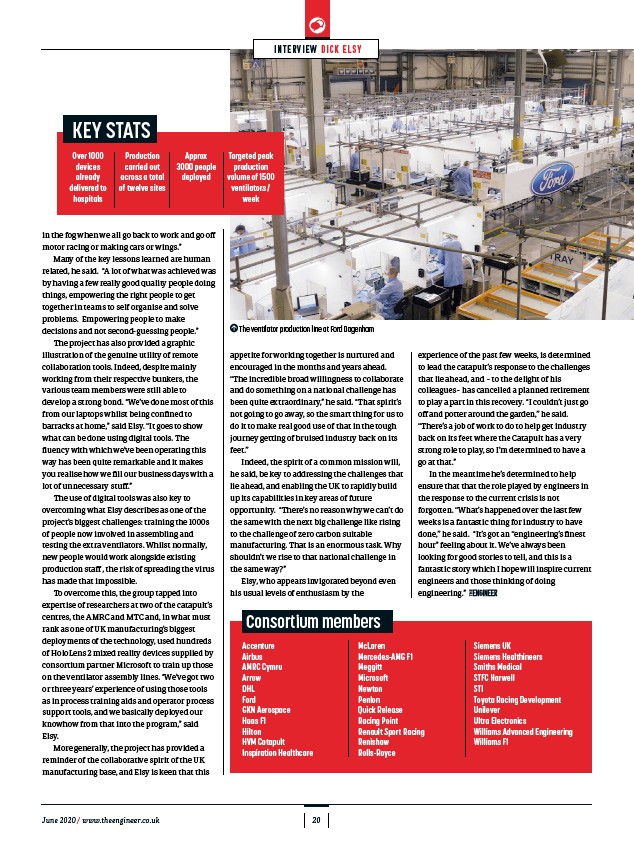
The ventilator production line at Ford Dagenham
/www.theengineer.co.uk